1.1.1. Conflict and Conflict Resolution Methods
Sources and solutions to conflict in elderly individuals
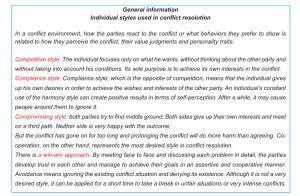
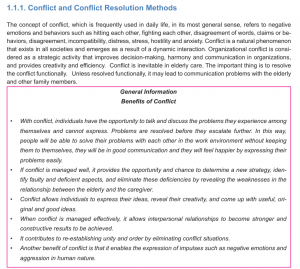
• The main sources of conflicts are based on individual differences, incompatibilities, disagreements, perception differences, competition and contradictions.
• There may be many reasons for conflict in elderly individuals. A significant part of these is related to com
munication. These can be listed as meaning difficulties, insufficient information exchange and impaired
communication channels. For example, when the elderly’s expectations from the caregiver do not match,
this may be a matter of conflict. The solution to this is to clearly state the care services to be provided to
the elderly, the responsibilities of the caregiver, and to minimize uncertainties, and to have clear people
and institutions other than the caregiver who will provide support, and for the elderly and the caregiver
to be clear on this issue. It is important to give the elderly person the right to participate in the decisions taken.
• Effective communication established according to the personal conditions and needs of elderly individuals appears as a critical technique in reducing or managing conflicts. For this reason, it is useful to use resources such as including expressive contact in the communication process, being a good listener,
developing empathy skills and communicating assertively. While performing the task, including emotional
contact to strengthen the feelings of closeness and sincerity perceived by the elderly can create quality communication.
• Developing empathy skills enables the establishment of trust in care and treatment services. Cognitive
empathy is about understanding the mental state of the individual in front of us and grasping their way of
thinking. Emotional empathy is the ability to understand emotional states and feelings. Empathy should
be taught to caregivers as a technique that can be learned and developed. Conducting motivation-focused interviews, in other words, asking the elderly person’s opinion about care alternatives, increasingtheir self-confidence and making them hopeful, and reinforcing them that they can solve their problems
are among the communication techniques used in conflict resolution. During this entire process, it is
necessary not to speak loudly, not to be aggressive, to make eye contact and to be respectful, but while
doing these, it is necessary to convey one’s own thoughts and feelings to the other party, in other words, to prefer assertive communication.
• Conflicts occur with family members due to reasons such as role ambiguity, lack of communication and
trust. Family members’ worries and feelings of guilt can reinforce conflict situations. The anger and regrets of elderly individuals can be alleviated thanks to intervention plans that include them in care activities. In these intervention programs, situations that impair the quality of communication can be discussed
through exercises such as brainstorming; By using the role-playing technique to increase listening skills,
verbal and non-verbal communication elements that hinder communication can be explained with examp
les. Considering the role of cultural differences in conflicts, examples of communication accidents caused
by cultural and ethnic differences can be given. Understanding differences in values and how these translate into open conflicts can be discussed. In joint sessions where family, caregivers and, if necessary,healthcare professionals come together, the parties come together to share their concerns and problems and plan ways to solve them.