
1.1. Communication Skills
It is very important to establish healthy communication with elderly people when caring for them. When it
is not possible to establish communication with the elderly, the age is defined as ‘difficult elderly’. There
are different ways to establish healthy communication with each age group, depending on their characteristics.
However, there are some basic approaches when communicating with older people. First of all,
elderly people who receive care can be agitated individuals who demand attention and can show intense
emotional reactions. For this reason, the caregiver; A friendly and sincere interest is considered the most
effective attitude and behavior shown at the beginning of communication. On the contrary, an indifferent,
angry and sullen communication style in communication with the elderly who have feelings such as anxiety
and fear due to their age may have a negative impact on the health of the elderly. When communicating
with the elderly caregiver;
• Must be able to express himself accurately and fluently,
• Must determine an appropriate language and communication style
• Must be able to try to understand what the elderly person is experiencing.
Difficulties encountered when communicating with the elderly;
When communicating with the elderly, some communication difficulties may be experienced, which may
arise from the elderly, the caregiver or the environment. Examples of these are given in the table below.
Table: Difficulties encountered when communicating with the elderly
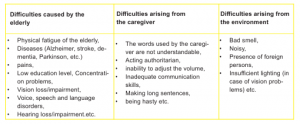
Things to consider when communicating with the elderly:
There are some sensitivities depending on the characteristics of the elderly that the caregiver should pay
attention to when communicating with the elderly. These;
• Before communicating, he/she should be ensured to use assistive devices (glasses, hearing aids, etc.)
if he/she has/uses them.
• Appropriate arrangements should be made to place personal belongings (walking stick, walker, umbrella, etc.) within easy reach.
• When communicating with elderly people, the socio-cultural aspect of the elderly should be taken into
consideration, and care should be taken to speak in a clear and understandable style. Addressing them
by their title, if any, brings out positive emotions in many elderly people.
• The questions to be asked to the elderly should be clear and understandable and they should be given
time to answer the questions asked.
• While speaking, the tone of voice should be adjusted well. Since elderly people are more spiritually
sensitive and fragile than other individuals, they should be spoken to more calmly and slowly, in a way
that they can hear, without shouting.
• Care should be taken to establish eye contact with the elderly.
• The elderly should be given the opportunity to ask questions.
• Care should be taken not to be judgmental while listening to the elderly.
• Elderly people should never be spoken to as if they were talking to children.
• Since bone and muscle structures weaken in old age, sudden and rapid movements should be avoided,
otherwise fractures may occur.
• When giving information to the elderly about their old age, it should be avoided to use medical terms
(For example: you can forget some things instead of “you have dementia”). Short and simple sentences
should be made.
• Elderly spouses may also need help. Bringing his/her spouse to a health institution will be frightening
and worrying, especially in emergency situations, so the elderly person should be informed about what
is being done and for what purpose.
Communication with the elderly according to the characteristics of the elderly;
Depending on the different health problems that occur with old age, it may be necessary to resort to different communication methods with the elderly. Different methods can be used to communicate with theelderly who are paralyzed, unconscious, angry, panicked, refuse treatment and have mental health problems.
Communication with the paralyzed elderly:
Paralyzed elderly people may have difficulty in communicating with other individuals due to their physical disability. The paralyzed individual may not be able to communicate eye-to-eye because he cannot stand in a suitable position. To do this, you should stand in front of the elderly person and establish eye contact. For the elderly who have difficulty communicating due to their physical disabilities, equipment such as mobility aids, call bells, telephones, paper and pens can be used. Face-to-face communication should be established with paralyzed elderly people whose hearing is impaired in a well-lit, quiet environment. If the elderly person uses a hearing aid, it should be checked whether the device is working or not. The paralyzed elderly
person may need his wheelchair to be used by someone else. Before moving the chair, the elderly person should be asked where he wants to go each time. Appropriate ways should be tried to encourage the paralyzed elderly person’s communication. For example, opportunities should be created to be interested inobjects or pictures belonging to the elderly person and to talk about them. The elderly person’s responses may have slowed down, and he should be given time to respond when spoken to. The paralyzed elderly person may laugh or cry uncontrollably. The elderly person should be asked whether he or she experiences emotions such as happiness or sadness. The factors that trigger this condition should be learned and the elderly should be prevented as much as possible. If the elderly person cannot express his emotions correctly, it should not be forgotten that it is common to experience such emotions after a stroke.
Communication with an unconscious elderly person;
Consciousness is the state of being unaware of oneself and one’s environment. Hearing is the last sense to be lost, and unconscious elderly people still retain their hearing. For this reason, what the elderly hear should not be forgotten and the assumption that there is no unconscious elderly should be adopted, and the elderly should be addressed by their name; Verbal communication should be established using simple and concrete terms and short and clear sentences. Assuming that even elderly people who do not respond to stimuli can hear what is said around them, any procedures to be performed should be explained to such elderly people. Communication should be established even if it is one-way. Additionally, other ways of communicating with the elderly should be tried. For example, studies have shown the positive effects of familiar voices and it has been stated that hearing familiar voices may have effects on the clinical condition of an elderly person. Knowing the wishes of these elderly people can only be done with the help of their relatives.
It is important to keep flowers in the room of an elderly person who likes the smell of flowers, to play the type of music the elderly person likes, and to meet with the family in the presence of the elderly person, if necessary, in meeting the needs of the elderly person. The fact that caregivers of unconscious elderly people cannot answer the elderly people and do not know what the elderly people’s answers are may cause them to have difficulty in communicating with these elderly people. However, it should not be forgotten that communication is a need, and efforts should be made to communicate with the elderly. In unconscious elderly people, not only what is said but also the tone of voice and the emotions behind it are important. The caregiver’s tone of voice and expression of emotions can reduce the anxiety of the elderly and create a sense of trust.
For unconscious elderly people:
• Daily cleaning should be continued.
• The elderly should be talked to.
• The family should talk to the elderly.
• Every procedure to be done to the elderly person should be explained.
• The privacy of the elderly should be protected.
Communication with the elderly who are experiencing anger;
Losses and problems such as the elderly role, needing someone, pain, changes in the body, loss of body control, being away from home and family, and being disconnected from daily life may pose a threat to the biological, psychological and social integrity of the elderly. Or the elderly person may perceive it this way. The elderly person may not be able to find the words to express his fears and other emotions. For this reason, elderly people may react such as refusing their treatments or turning to verbal behavioral threats. While elderly people can express their anger directly by verbally teasing, using sarcastic words or raising their voices, they can also express their anger indirectly by refusing treatment, refusing care, not cooperating and making frequent requests.
What should the caregiver do against the anger of the elderly?
• The caregiver must first recognize anger, then accept, understand and respond. It is easy to recognize anger if the elder expresses that he or she is angry, but elders often do not say it. Tone of voice and agitated behavior may indicate that the elderly person is angry.
• The reaction that disrupts communication in the face of anger is to hold the person who angered to account, to put him in his place, to lecture and to defend. In cases where the elderly person becomes angry unintentionally, it is important to investigate the cause of the anger. A sentence like “You seem
bored” helps the elderly person share his/her feelings with you.
• It should not be forgotten that the real problem is not the anger itself, but the way it is expressed.
• One should never engage in a power struggle with the elderly, should not become defensive, and should not respond with anger.
• He/she should keep his/her own emotions under control.
• He should speak calmly, leave the room if necessary and come back after a while.
• Must observe the behavior and body language of the elderly.
• The elderly should be allowed to show their emotions.
• The source of the elder’s anger should be investigated.
• The elderly should not be shouted at or fought with.
• If the elderly person is very angry, he should not be approached or touched.
• The feelings of the elderly should not be ignored. This prevents the source of anger from being found.
• What the elderly person says should be listened to patiently.
• If the elderly behaves in a harmful manner, they should be moved to a safe area.
• Time should be reserved for the elderly and patience should be exercised during this time.
• The elderly should not be judged for their angry behavior, and condescending, commanding attitudes and expressions that will increase their anger should be avoided.
• In medical applications that need to be performed, if there is a need to wait, the reason for this should be explained.
• Relatives of the elderly should be removed from the environment if they cause the elderly person’s anger to increase.
• What the elderly say should be listened to patiently.
• If the elderly behaves in a harmful manner, they should be moved to a safe area.
• Time should be allocated for the elderly and patience should be exercised during this time.
• The elderly should not be judged for their angry behavior, and condescending, commanding attitudes and expressions that will increase their anger should be avoided.
• In medical applications that need to be performed, if it is necessary to wait.The reason for this should be explained.
• If the elderly’s relatives cause the elderly’s anger to increase It should be removed from its environment.
Communication with the elderly person experiencing panic:
Panic is a seizure that can occur unexpectedly, anywhere, and is a mixture of intense anxiety, anxiety, and fear. This seizure gives the person such an intense feeling of fear and uneasiness that he feels that something bad will happen, that his end is coming, or that he will die. A person who experiences this storm of fear naturally shows the behavior of escaping and moving away from that environment and situation. Panic disorder can be seen in many psychosocial disorders and some physiological senescence (overactivity of the thyroid gland, low blood sugar, infectious senescence, anemia, etc.). During a panic attack, physical symptoms such as difficulty breathing, feeling of suffocation, dizziness, fainting, palpitations, increased heart rate, tremors, nausea, abdominal discomfort, numbness, tingling sensation, hot flashes, chills, and chest pain occur. In addition to physical symptoms, cognitive symptoms such as fear of death, fear of going crazy, or fear of losing control are often added to the picture.
What should be done to communicate with the elderly person experiencing panic?
• If the elderly person is in panic, he is taken to a place where he can be comfortable and there is no one
around him. The individual should be treated calmly and the individual should be made to feel safe.
First of all, in order to relieve the panic experienced by the individual, it must be understood what the
problem is. If necessary, questions should be asked to the elderly person and feedback should be given.
• It is a very appropriate and comforting behavior to tell the person who is having a panic attack that
this situation will pass in 10-15 minutes and that he needs to calm down and to have him do breathing
exercises. Intervention should not be made without fully understanding the problem.
Communication with the elderly person who refuses treatment (mutually agreeing on the conditions of care);
Elderly people may sometimes face limitations due to their addictions and disabilities. Especially in clinics with long hospital stays, such as surgery or internal medicine, the elderly may not accept treatment because they feel their independence is restricted. Reasons such as the elderly being in a passive position, not being able to participate in decisions, not being allowed to leave their room or bed, and changing habits cause the elderly to feel inadequate, hindered and restricted. In this case, it makes him feel worse and more depressed.
In such cases;
• The elderly should not be left to their own devices.
• Health personnel should not personalize the behavior of the elderly.
• The elderly should be encouraged to share his/her feelings. should be given.
• Opportunity to grieve, express emotions, accept
• Loss hould be presented.
• The fears and concerns of the elderly should be shared.
• The elderly should not be condemned for their feelings and thoughts.
• Non-verbal behaviors of the elderly should be observed.
• The reasons why the elderly person refuses treatment should be discussed.
• The elderly should be allowed to control what will be done for him/her.
• Cooperation must be ensured
Communication with the elderly with severely impaired mental health
It is difficult to define mental health. Mental health is being in harmony and balance with oneself and other people. This harmony is not bound by strict rules, but carries variability and a certain amount of flexibility. It is the state of being in harmony with oneself and being free from unexplained and long-lasting delusions,
anxiety, fear and doubts. Perception and thought disorders may cause disruptions in the communication of such elderly people. All principles related to communication (respect, empathy, acceptance, professional communication, etc.) are also valid in communicating with elderly people who have unrealistic perceptions and thoughts.
In addition to these principles;
• The individual’s unrealistic perceptions and thoughts should not be supported. When the elderly person
talks about his hallucination, change the subject and ask, if necessary, “Do you feel that way?” Brief
explanations should be made without further ado.
• The thought content of the elderly person may be distorted or speech may be interrupted while spea
king. Therefore, when communicating with the elderly, there should be no rush, questions should be
asked, repetitions and summaries should be made to ensure that what is said is understood.
• Individuals whose connection with reality is impaired may not be able to make sense of abstract con
cepts. For this reason, abstract concepts should not be used when communicating with an individual
with psychological problems, and concrete and short expressions should be used to improve communication.
• When communicating with individuals with psychological problems, it is necessary to pay more attenti on to all communication-related principles in order to avoid misunderstandings. When communicating with an individual with a psychological problem, a safe distance should be observed and the elderly person should be prevented from harming themselves, their caregivers and their team. Distance should be used wisely during communication.
Communication with the elderly in terminal period:
During this period, both the elderly and the family experience similar stages. After a period of shock, dis
belief, and denial, periods of anger, bargaining, depression, and acceptance may occur. Anger that is not
addressed in the terminal period is the factor that brings the person step by step closer to depression.
Understanding anger, letting it go, and supporting those who care for the elderly to gain strength are im
portant approaches. The main purpose of communicating with the elderly who are living their last days is
to improve the quality of their remaining life. Ensuring that emotions are shared appropriately, helping them
make short-targeted plans for the remaining days, reviewing the past and evaluating what can be done
today, talking about what they want to do on their behalf in the future are some of the actions that can be
taken to improve their quality of life.
The caregiver of the elderly in the terminal period is expected to have some basic competencies;
• Establishing empathy
• Listening
• Providing information
• Identifying stress factors and elderly needs.
Communicating with the elderly in terminal period;
• The caregiver must be ready to communicate with the elderly person, and must especially be able to
control his/her emotions.
• Communication with the elderly should not be tried to fit into a short time. One should be ready to listen
to the elderly person and take time. As much time as possible should be spent with the elderly.
• The caregiver must create confidence that he can be with the elderly person as long as he wants.
• All transactions should be explained along with their purposes.
• The elderly person should be asked what he knows and perceives about the situation he is in.
• One should be honest and compassionate towards the elderly.
• Open-ended questions should be asked to help the elderly share their feelings.
• For example; When the elder says, “My time is up,” I say, “Can you tell me about your concerns about
this issue?” It can be said.
• An approach that encourages the elderly to reveal his/her emotional state should be taken.
• The elderly person should be allowed to remain silent or cry.
• The should be aware of the role of listener when the elderly explains his/her feelings and thoughts.
• The elderly should be included in the decision-making process.
• He should be supported in making plans for the goals he can achieve in the short term. What they can
do during the day should be evaluated.
• Family photos and memories should be discussed, and emphasis should be placed on past achieve
ments and useful work done. It may be useful to talk about what you want to do on your behalf in the
future.
• Touch is a therapeutic approach and can be used where appropriate. On the other hand, some elderly
people may not like to be touched. The elderly should be approached by taking into account cultural
and personal differences.
• If available opportunities are suitable, communication with family members should be facilitated. One
should ask whether he/she has personal difficulties or concerns in communicating with his/her family.
• One should be aware of the need to maintain hope. For a terminally ill person, hope may include living
until his son’s wedding, making an expected sale, or experiencing less pain. Family photos and memo
ries should be discussed, and emphasis should be placed on past achievements and useful work done.
• It may be useful to talk about what you want to do on your behalf in the future.
• Touch is a therapeutic approach and can be used where appropriate. On the other hand, some elderly
people may not like to be touched. The elderly should be approached by taking into account cultural
and personal differences.
• If available opportunities are appropriate, communication with family members should be facilitated. It
should be asked whether he has personal difficulties in communicating with his family or whether he
has any concerns.
• One should be aware of the need to maintain hope. For a terminally ill person, hope may include living
until his son’s wedding, making an expected sale, or experiencing less pain.
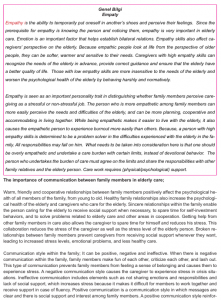
ces belonging by increasing sharing not only in crisis situations but also on happy days. A good relationship within the family requires family members to listen to each other and understand their messages correctly.
Communicating clearly using I language involves both being understood and not blaming the other party. Establishing open communication with family members using I language without being defensive also provides modeling for positive communication and problem solving. Spending time with family members will increase
psychological well-being. Due to their responsibilities, caregivers are limited in spending time with family members. For caregivers,
spending time with family, with the organization and assistance of other family members, will reduce feelings of loneliness and isolation and increase psychological well-being.
The relationship of family members with the elderly is also important. Accepting the elderly in the family not as dependent and passive individuals, but as experienced individuals who know their own responsibilities will increase the quality of relationships with the elderly. Giving elderly people responsibilities within the family where they can use their strengths will make them feel valuable and purposeful.